

Gecko Nutrition - Mango Papaya
Sale price
€9,89
Tax included
Shipping calculated at checkout
Benefits at a Glance
- Gecko Nutrition as a Feed Mix
- Simply mix with water
- Available in various sizes
Gecko Nutrition Mango & Papaya for Crested Geckos
Gecko Nutrition Mango & Papaya – tropical insect and fruit-based complete food for crested geckos. This variety combines mango and papaya with an insect mix of black soldier fly larvae, mealworms, and crickets. The food is mixed with water from a powder, offered fresh, and is intended for regular feeding. Made in Germany.
Why keepers choose this variety:
– Mango + Papaya: tropical fruit combination for more variety in the feeding plan
– No banana as a main component: useful for keepers who are deliberately looking for a different taste profile
– Complete food: for the regular feeding of crested geckos
– Insect and fruit-based: combines fruit components with protein-rich ingredients
– Powder for mixing: fresh portions, clean preparation, and suitable for everyday use
– Vitamins and minerals: already included in the recipe
Typical applications (practical):
– regular feeding of crested geckos
– changing varieties for more variety in the feeding plan
– clean portioning of freshly mixed gecko food
– useful for keepers looking for a complete food without banana as a main component
Preparation & Use:
– mix 1 part powder with 2 parts water
– let stand briefly until the mixture thickens
– target consistency: similar to ketchup
– offer 2–3 evenings per week, depending on feeding behavior
– remove leftovers after 24 hours at the latest
Magnetic gecko feeding dishes, suitable holders, and other accessories for feeding in the terrarium are ideal for a clean feeding area.
Composition, Ingredients & Notes
Composition:
Insects (black soldier fly larvae, mealworms, crickets) 14%, mango 13%, papaya 13%, date 13%, whey protein isolate, micellar casein, pea protein, whole grain rice, coconut, flaxseed, monocalcium phosphate, calcium carbonate, flower pollen, bee honey, carrot, beetroot, magnesium oxide, turmeric root, brown algae, wheat pregelatinized starch, spirulina
Analytical Constituents:
Crude protein 26.7%, crude ash 8.7%, crude fat 5.3%, crude fiber 3%, calcium 2%
Additives:
Nutritional additives per kg: Manganese as glycine-manganese chelate, hydrate (3b506) 20 mg, Vitamin A (3a672a) 12,000 I.U., Vitamin D3 (3a671) 1,600 I.U., Vitamin B1 (3a821) 490 mg, Vitamin B2 (3a825ii) 160 mg, Vitamin B6 (3a831) 42 mg, Vitamin B12 (3a835) 2,600 mcg, Niacinamide (3a315) 5 mg, Calcium D-pantothenate (3a841) 1.25 mg, Folic acid (3a316) 0.3 mg, Iron as iron(II) glycine chelate, hydrate (3b108) 50 mg, Selenium as sodium selenite (3b801) 0.16 mg
Technological additives per kg: Xanthan gum (E 415) 10,000 mg, Sorbic acid as potassium sorbate (1k202) 2,500 mg, Lactic acid as calcium lactate (1a327) 3,837 mg; the simultaneous use of different organic acids or their salts is contraindicated if the maximum permissible limit for one or more of them is reached or nearly reached.
Sensory additives: Flavoring mixture
Notes:
Mix 1 part powder with 2 parts water (by volume). Initially, the mixture appears slightly liquid but thickens within a few minutes. The consistency should be similar to ketchup; the ratio can be adjusted slightly. Depending on the animals' feeding behavior, feeding 2–3 evenings per week is recommended. Leftover food should be removed after 24 hours. Store in a cool, dry place after opening. Prepared food lasts 3–4 days in the refrigerator.
Not suitable for human consumption.
Manufacturer:
Terraristik Hörnchen GmbH
Magdeburger Straße 6
50126 Bergheim
Which geckos is Gecko Nutrition Mango & Papaya suitable for?
This variety was developed for crested geckos (Correlophus ciliatus). It is also interesting for other fruit-eating reptiles. The appropriate variety always depends on the species, age, and individual feeding behavior.
How do I properly mix Gecko Nutrition Mango & Papaya?
The powder is mixed in a ratio of 1 part powder to 2 parts water. The mixture will initially appear liquid and will thicken after a short time. The goal is a consistency similar to ketchup.
How often should I feed Gecko Nutrition Mango & Papaya?
Depending on the animal and its feeding behavior, 2–3 times a week is a common guideline. Juveniles or animals with different needs may require other intervals.
What is the difference to varieties with banana as the main component?
This variety is explicitly formulated without banana as a main component. This makes it suitable for keepers who consciously want to use a different fruit profile within the Gecko Nutrition range.
How long does mixed food remain fresh?
Opened portions in the terrarium should be removed after 24 hours at the latest. According to the manufacturer, prepared food lasts 3–4 days in the refrigerator.
Blog posts
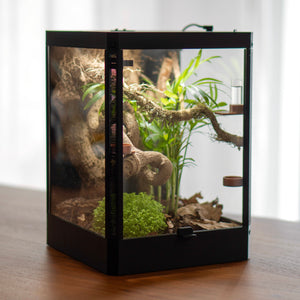
BioFaunaCube: Modular terrarium for keeping and breeding
BioFaunaCube at a glance: Which size fits your project, how does the modular system work, and which accessories make sense?
Read more

When the Terrarium Turns Into a Dollhouse: Why Kitschy Mini-Furniture, 3D Trees, Backdrops & More Can Harm Animals
Animals are living beings, not accessories. Yet, more and more products on the market resemble items meant for a dol...
Read more
Breeding Drosophila: Guide to Stable Cultures
Drosophila breeding made easy: How to set up fruit fly cultures cleanly, organize them sensibly, and feed them in a controlled way.
Read more

